
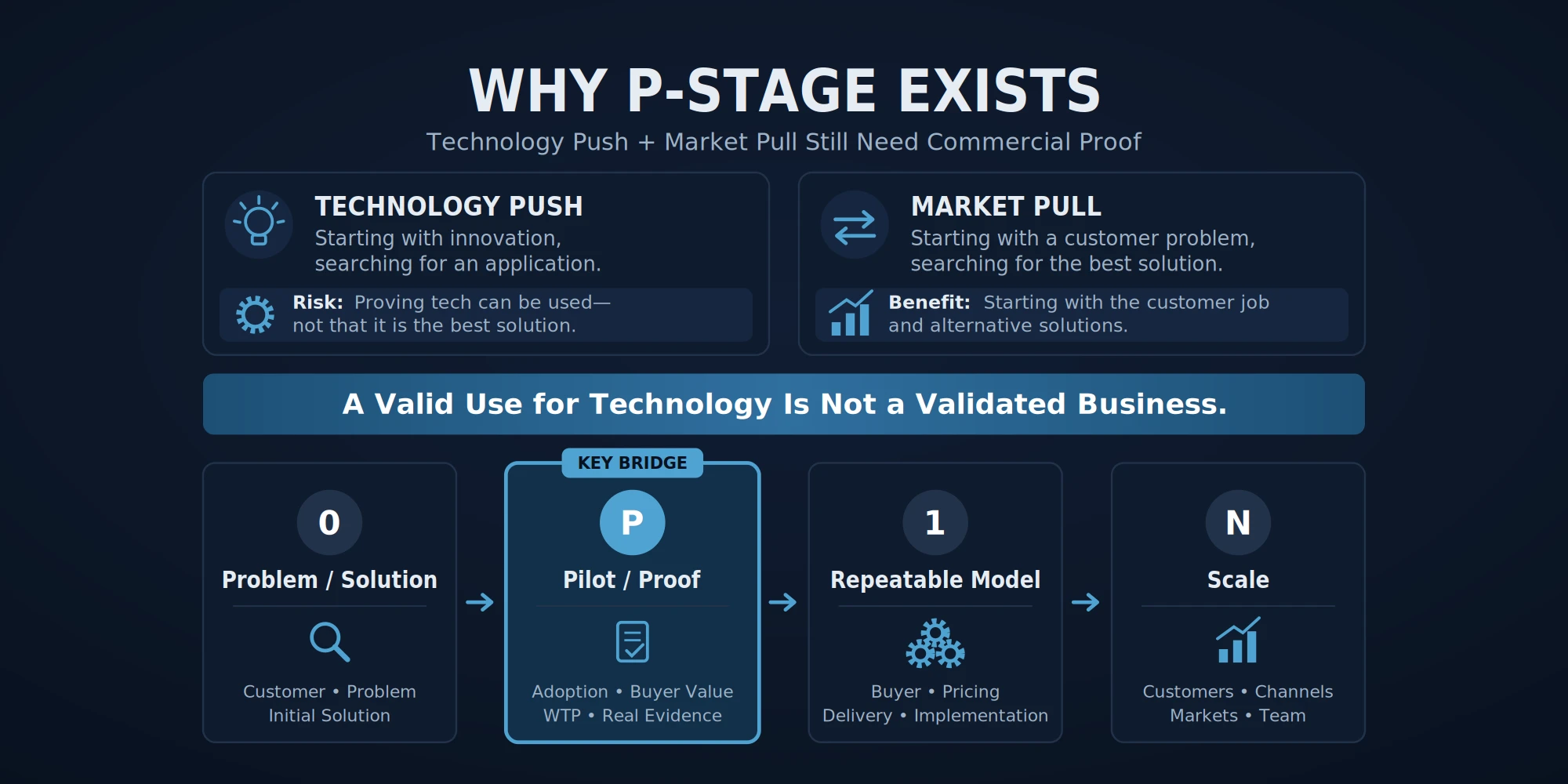
A valid use for technology is not a validated business.
A technology can work exactly as designed and still fail commercially. That distinction is one reason I’ve been developing the Zero → Proof → Repeatable Model → Scale (0 → P → 1 → N) framework.
I often hear Technology Push contrasted with Market Pull, almost as if Push is inherently wrong and Pull is always right. I don’t see it that way.
Push is a valid starting point for many deep-tech, university, patent-driven, and scientific ventures, it is how the journey begins: we created something important; where can it create value?
Pull starts from the other direction: there is an important customer problem; what is the best way to solve it?
Both can create innovation. The problem is confusing “our technology can solve this problem” with “this is the best commercial solution.”
That is the valid use trap.
Technical teams naturally ask whether the technology can solve a problem. Commercialization asks harder questions: Is the pain strong enough for customers to change behavior? Is the solution materially better than the current alternative? Does it fit the workflow? Who is the buyer? Is the value measurable? Will they pay?
A technically successful product does not answer all of those questions. That is why I believe a distinct P-stage matters.
0 – Problem / Solution
Identify the customer, problem, and initial solution. Push may create the innovation; Pull helps identify where it creates meaningful value.
P – Pilot / Proof
Test the solution in the real environment — including adoption, buyer value, workflow fit, economics, and willingness to pay.
This is where we move from “the product works” to “the business can work.”
1 – Repeatable Model
Show that the customer, buyer, pricing, sales process, implementation, and delivery can work beyond one friendly customer or founder-led engagement.
N – Scale
Systematically grow what has already been commercially proven and is becoming repeatable.
Before scaling, I would ask three questions:
Are we proving technical feasibility or commercial necessity?
Does the customer care enough to change from the status quo?
Does the pilot prove the economics or only the mechanics?
Working technology is evidence. Adoption, measurable value, and willingness to pay are stronger commercial evidence.
Are we trying to go from 0→1→N before we have really completed P→1?
Scaling an unproven model does not remove uncertainty. It can amplify it.
My simplified view:
Technology Push creates possibilities. Market Pull identifies valuable problems. P establishes commercial proof. 1 establishes repeatability. N scales what has earned the right to grow.
P closes the gap between “the product works” and “the business can work.”
Where do you see teams getting stuck most often: proving the technology, proving buyer value, or making the model repeatable?