
The Missing P Between 0 and 1: Why Commercial Proof Deserves Its Own Stage
Most startups already run pilots. That isn’t the insight.
The opportunity is to treat Proof as a distinct stage between 0 and 1 — with explicit hypotheses, measurable commercial evidence, and clear exit criteria before committing significant resources to repeatability and scale.
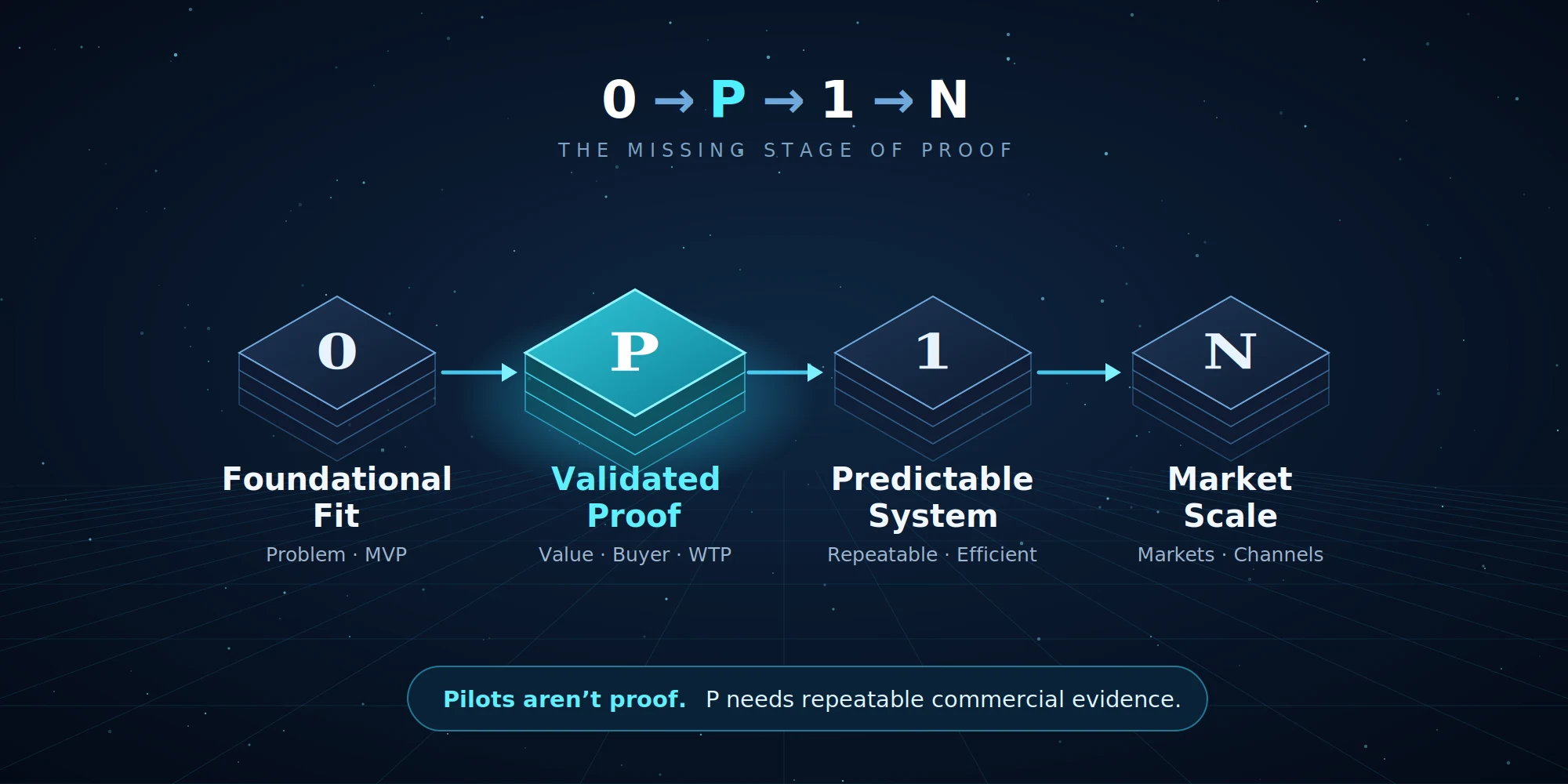
I’ve been developing this as the 0→P→1→N framework.
0 — Problem / Solution
Find the right customer problem, target segment, and initial solution. MVPs and early experiments live here.
P — Pilot / Proof
Use structured pilots or other targeted proof mechanisms to establish that the product works in the customer’s real environment — and, more importantly, that it creates measurable value, has a clear economic buyer, supports a credible price, and can lead to continued payment.
The goal is not simply technical validation. It is commercial proof.
1 — Repeatable Model
The product, workflow, buyer, pricing, implementation, and delivery model begin to become repeatable and efficient.
N — Scale
Scale customers, channels, markets, teams, and capital.
The distinction matters because running a pilot does not mean a startup has completed the P stage.
A startup should earn the move from P→1 only when it has enough evidence that a repeatable commercial model can work — not simply because the MVP works or a few friendly customers liked the product.
This is the first article in ICL’s 0→P→1→N series. Next, I’ll explore the P→1 gate: what commercial evidence should a company establish before investing heavily in building a repeatable model — and ultimately scaling it?